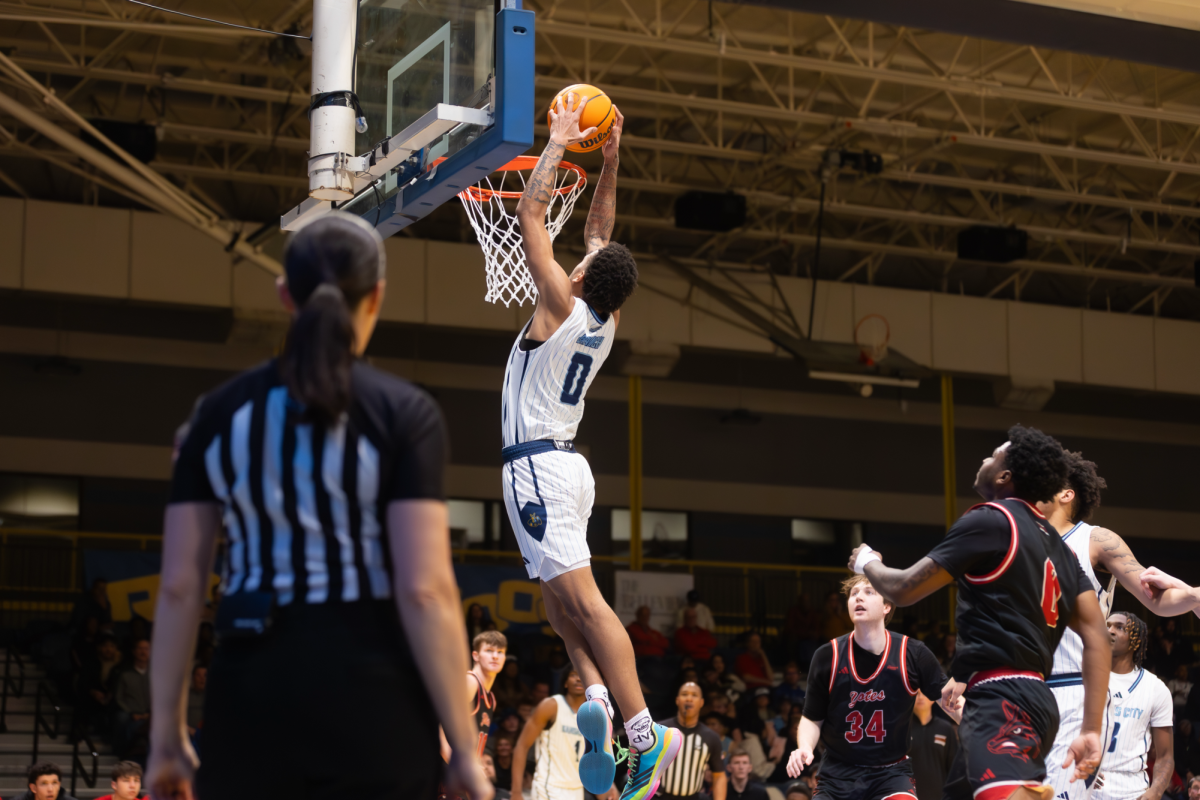
Female coaches at UMKC are shaping the next generation of athletes, offering inspiration and guidance both on and off the court.
Emani Bennett, a Psychology major at UMKC, plays for the women’s basketball team with hopes of going pro or competing overseas one day.
Bennett said that being a student-athlete is a privilege.
“You get to play your sport, and still go to school.”
Bennett’s experience with the majority of women coaches created role models for her to look up to. The head coach at UMKC, Dionnah Jackson-Durrett, not only played high-level power five basketball in college but was also drafted to the WNBA.
“I think playing for a coach that has had that success, it’s inspiring and it gives you someone to look up to,” said Bennett.
She added that since women coaches have that experience, they understand what it’s like to be a woman in these sports fields.
Christi Posey, UMKC’s head volleyball coach, said she began coaching after having a wonderful experience herself as a student athlete. She hoped to continue this experience for other young girls now as an adult.
“I just know what I appreciated with my coaches, that I wasn’t a female athlete, I was an athlete,” Posey said.
Posey recalled how Title IX gave her the chance. As a sophomore in high school, she was finally able to join sports teams that previously had been off-limits.
Regarding representation in the sports scene, particularly as coaches, Posey said, “I think anytime you have somebody who looks like you and shows a really good example of what it could be, then I think that’s an advantage.”
The recent displays of protest for equal pay in women’s sports bring up many conversations around the equality of women athletes compared to their male counterparts.
Bennett explained how, during the prior season, the men’s basketball team consistently sold out games, while the women’s team played smaller crowds. Yet, the women’s basketball team had a better record than the men’s at UMKC,
“We had a decent crowd, but at the time, we were coming back from a losing streak. I just feel like having that support…I feel like that would have helped us even more,” said Bennett.
The support women coaches provide for their female athletes helps fill that gap, offering encouragement and motivation to keep pushing forward.
“[Having these conversations is] part of the responsibility as an adult coach, but then as a female coach, it’s part of what makes my job rewarding,” said Posey. “To help them, once again, to advocate for themselves.”
She goes on to explain how the women coaches she had inspired her not only to get into the sport, but to grow the number of women coaches as well to create more representation.
“Coaches are coaches, but I do think that there is a connection that is different with a female coach to a female athlete, and I try to do my best to be a good role model for all our student athletes,” said Posey.
Bennet said what she admires most about her female coaches is their passion for the job and the care they show their athletes.
“Our coach talks a lot about how the hard work we put into the game, and how much we sacrifice, the amount we do that is the amount we get out of it,” she said.
![[FILE] Roof blown off downtown business after storms on April 23.](https://kcroonews.com/wp-content/uploads/2026/04/Image-88-1200x900.jpg)



![[FILE] UMKC Men's basketball will move games to Kansas City Municipal Court for the 2026-2027 season.](https://kcroonews.com/wp-content/uploads/2018/09/UMKC-Mens-basketball-2-1024x576.jpg)