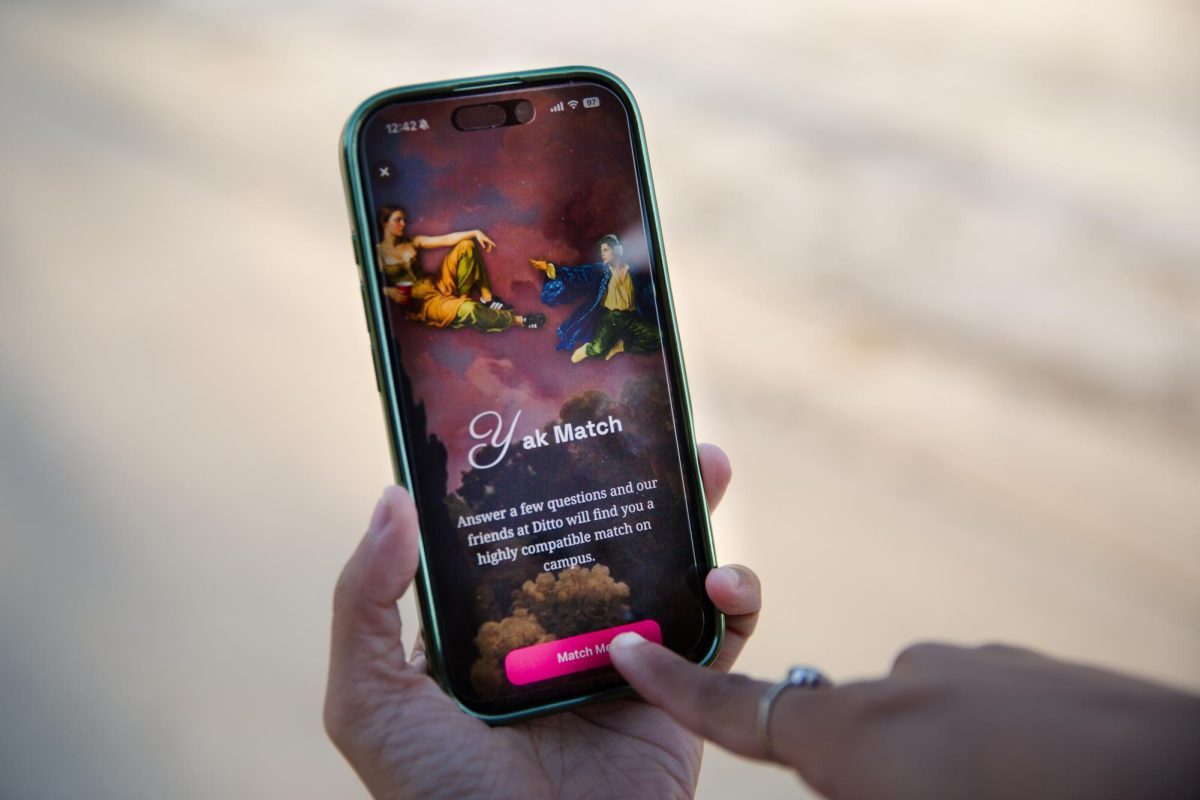
Yik Yak, the anonymous social media app for college campuses, has seen a significant increase in users at UMKC this fall 2025 semester, with mixed feedback from students.
Cesar Alonzo, a junior majoring in biology, has been an active user of Yik Yak since this summer. He said that’s when the app saw its revival, after students started sharing it with one another “like a weird infection.”
Though anonymous, Yik Yak requires users to provide an “.edu” email address when creating an account and limits users to only one college campus, meaning posts come from real UMKC students.
Alonzo said he’s met many real-life friends via Yik Yak, and finds that people on the app are generally helpful. He compared the app to a community bulletin board, where people can learn about different events and meet new people.
“Instead of being in specific buildings, it’s online and everyone on campus can see it,” he said.
One anonymous user, a sophomore who has been on the app since their freshman year, said Yik Yak provides UMKC students with a sense of community.
“Our campus isn’t very social,” they said. “This gives a space for people to talk about the UMKC student experience, where we otherwise just wouldn’t be talking at all.”
With the app’s anonymous nature, this widespread usage and visibility raises concerns for some students.
In 2017, Yik Yak was shut down after claims of cyberbullying and harassment happening on the app. It was relaunched in 2021 under new ownership, promising to combat these issues “by any means necessary.”
Some students, like a senior on the app who asked to remain anonymous, say the moderation is adequate. “People are very quick to report anything bad and argue against controversial posts,” she said. “Any discriminatory posts get taken down pretty fast.”
One student, a senior who asked to remain anonymous, expressed her concern over racist comments being made on the app about international students.
“We’re supposed to be a welcoming campus for international students and Yik Yak makes us look like a bunch of backwater bigots who have never seen someone from a different culture,” she said.
A sophomore on the app who asked to remain anonymous said she thinks the anonymity of the app brings out the worst in people. “Men are more creepy, people are freely racist, lots more threats or complaints…,” she said.
Specifically, she mentioned a recurring theme of male students making comments about female students.
“I think it’s definitely weird for people to constantly hit on girls anonymously,” she said. “It’s like they think they’re cooler when we can’t tell who it is, but I think it’s gross.”
Gray Boyle, a freshman majoring in media, art & design, shared that someone on the app had posted romantically-charged, anonymous comments about her. Boyle said she assumes this person has no ill intent, but it does creep her out.
“I haven’t even replied to any of their things cause it’s like I don’t want to give them any more attention than they’ve already received,” she said.
Aside from this incident, Boyle shared she’s had mostly positive experiences with Yik Yak, and doesn’t feel that cyberbullying is currently present on the app.
Boyle attributed the rise in popularity of Yik Yak to her 2025 cohort being the largest graduating high school class in U.S. history, with 3.5 million students.



![[FILE] The sorority banners in the Student Union.](https://kcroonews.com/wp-content/uploads/2024/09/IMG_6328-1-1200x756.jpg)