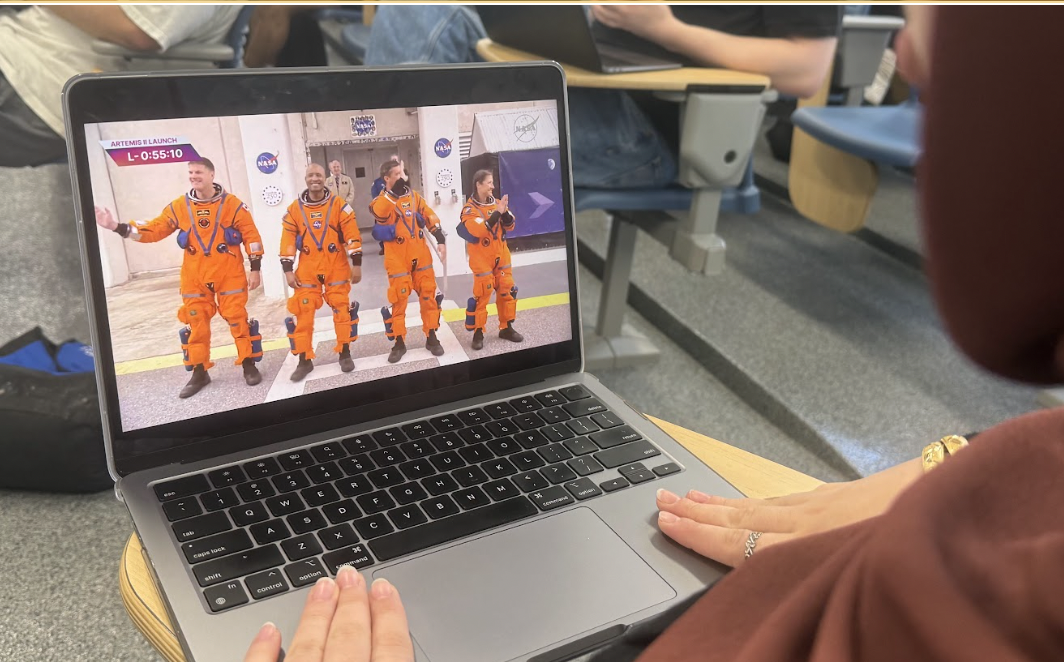
The historical Artemis II mission generated excitement for UMKC students, marking the first time in 52 years that anyone has been to the moon.
The 10-day mission, launching April 1 and landing April 10, was the farthest any person has traveled in space, orbiting Earth a couple of times, then traveling to the dark side of the moon.
“People are talking about space so much more than they have been in the past five years,” said Sydney Hubbard, electrical computer engineering junior and president of Roos in Space. “I feel like it will inspire people to put more interest in the technology to make it safer and better.”
UMKC does not currently have an aerospace engineering major; however, it has received a grant from NASA to fund Roos in Space to “generate outreach and inspiration for future generations of space explorers,” said Hubbard.
The crew consisted of four astronauts, Reid Wiseman, Victor Glover, Christina Koch and Jeremy Hansen. Marking the first woman (Koch), the first person of color (Glover) and Canadian (Hansen) to travel to the moon.
Charlie Blackwell-Thompson was also the first female launch director for NASA, calling for both Artemis I and Artemis II.
“I wasn’t really into it before, but now I am. I watched the clip when they went around the dark side, and they named that one spot after [Commander Wiseman’s] late wife. I cried, that was so beautiful,” said biology freshman Emily Grant.
The initial launch was scheduled to be as early as 2019, but was later pushed back.
It was delayed again from its planned launch in February due to a hydrogen leak. Additional delays were due to budget constraints and ensuring the safety of the astronauts.
“For every dollar you give in tax dollars to Uncle Sam, it’s only two pennies, 2% of every dollar you give goes to all of science. NASA only gets less than half a penny for every tax dollar,” said Dr. Daniel McIntosh, professor of physics and astronomy. “Politically, people are in favor of science, but they’re not in favor of spending a lot of money.”
Proposed budget cuts by the Trump Administration to NASA may further delay future Artemis missions.
“I’m worried that the NASA budget will start to push out basic science as one of the primary functions,” said Dr. McIntosh. “It’s expensive to send people to places like the moon, it’s a lot cheaper to send little robots. Eventually, the goal is to build up to the point where we would send people to Mars, but it’s really expensive, and it’s risky.”
NASA has multiple ongoing missions that do not include astronauts aboard, including the Europa Clipper and the Mars 2020: Perseverance Rover.
While NASA has continually sent astronauts into space, overall public interest in sending people to the moon dwindled after the space race ended and fatal missions like the Challenger.
A return to the lunar surface is scheduled in early 2028, with the Artemis IV mission, which will act as the next stepping stone for humans landing on Mars.