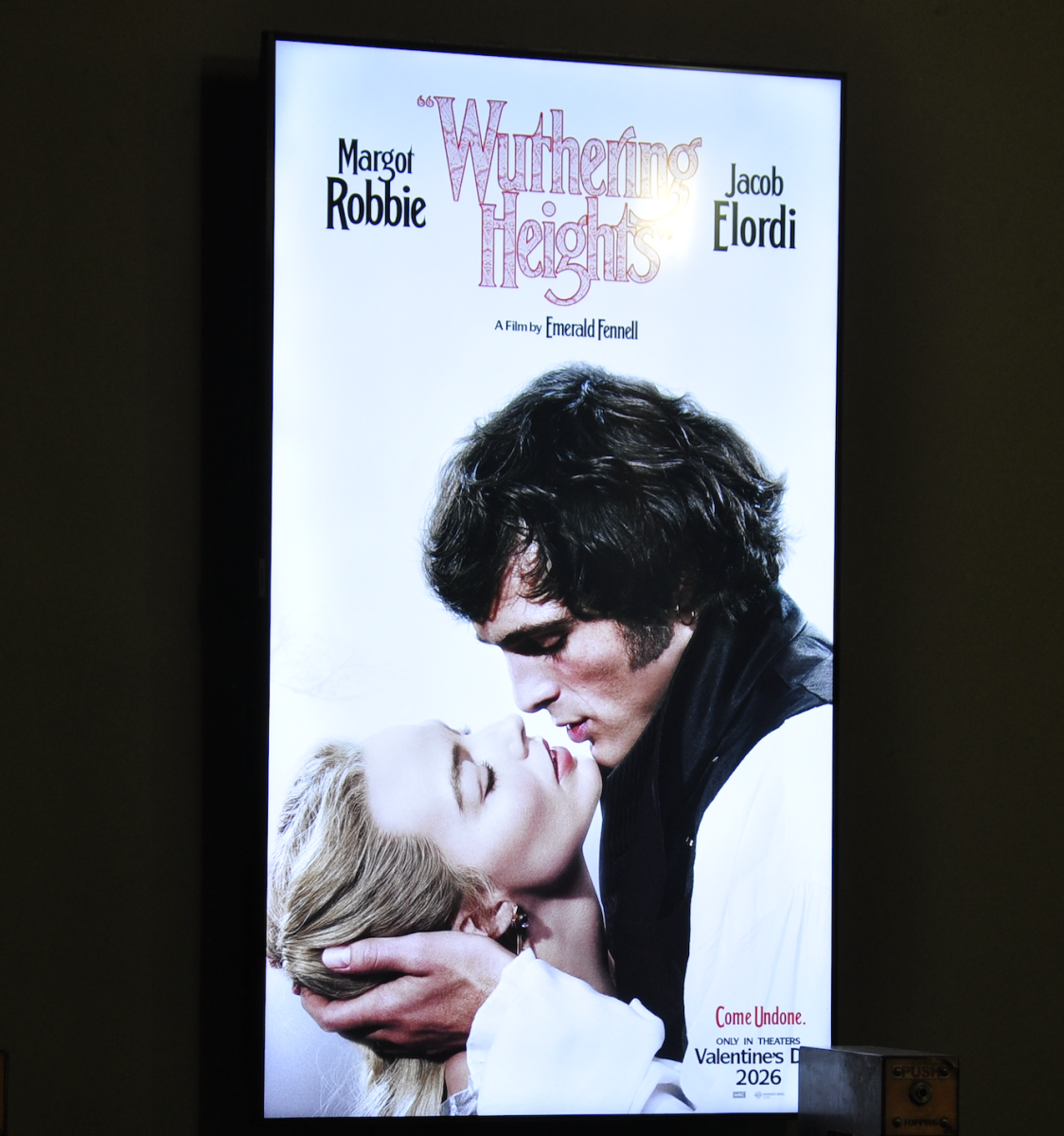
Drawing fans of both the novel and Charli XCX, who produced a truly unique score for the film, “Wuthering Heights” is easily one of the most beautiful films in a long time, but narratively one of the most unsatisfying.
The story follows Catherine (Margot Robbie), a young woman from a wealthy English family, and Heathcliff (Jacob Elordi), a lower class outsider who grows up in her household. Their friendship quickly evolves into a passionate, complicated love until social expectations and misunderstandings pull them apart, only for them to reunite and explore the dark realities of human fantasy.
Visually, this film is breathtaking. The cinematography, set design, and costumes all paint a world drenched in vibrant colors and distinct metaphors. The lushly grim Wuthering Heights estate and its surrounding rocky moorlands contrast beautifully with the off-kilter fairytale extravagance of Thushcross Grange. The decision to have the interiors of Thushcross Grange take on an almost anatomic appeal is wildly unique. It’s rooms that resemble either skin or blood, one of which even having a fireplace mantle with stone hands clawing away from the flame. These elements perfectly reflect the film’s intense emotional themes and character beats.
The acting was solid but complicated. Robbie gives Catherine a strong emotional intensity, and Elordi played Heathcliff’s brooding darkness effectively. However, the chemistry between them feels uneven. At times, it is like two good performances happening side by side instead of one shared emotional connection. The issue may stem from both characters being in their late teens throughout the majority of the book, whereas both Robbie and Elordi clearly aren’t. So, the explicit scenes and attitudes the two share come off as unrealistic and borderline creepy rather than tragically juvenile.
The biggest flaw is pacing. The film strangely feels both in a hurry and not. Some emotional beats rush by while others seem to drag on and even repeat, especially during the middle section. As such, dramatic tension feels sporadic, requiring the final epilogue sequence to hit the emotional beats that were otherwise drowned out in the middle and latter half of the film.
Though the film is adapted from a novel of the same name, it felt more like scenes depicting pages of a book rather than adapting them into a fully realized cinematic experience. “Wuthering Heights” is a beautiful film with real effort in its visuals, sets, and costumes, but strong images cannot atone for weak pacing and uneven romantic chemistry.