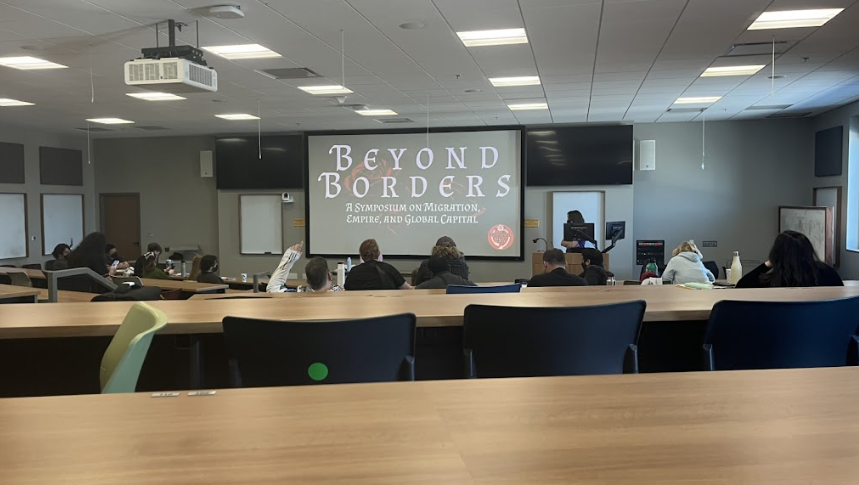
The Kansas City DSA, in partnership with the UMKC branch of YDSA, hosted a “Beyond Borders Symposium” on Saturday, March 14, at Miller Nichols Library. The event was a public seminar on migration, empire and global capital.
Over 50 people, including UMKC students, attended the event throughout the day. Activities included breakout rooms, action workshops and a keynote panel.
Samuel Lamar, a junior history major and vice chair of UMKC’s YDSA, said their organization’s involvement in the seminar included spreading the word on campus and putting on a student-led panel.
Lamar was happy with how their breakout room went, “I think it was pretty informative about what students can do to try to be involved.” Lamar said their panel focused on the current situation regarding ICE, with roos in mind.
Lamar said every student should attend a know your rights rapid response training class at least once.
“Students are also a target. You can’t sit this out. You can’t just be apathetic, you can’t just be conformists, this is something that affects you too,” Lamar said.
Ainsley Heffern, a freshman sociology major and co-chair of UMKC’s YDSA, runs rapid response training sessions regularly.
“We need our student body trained,” Heffern said. “Especially in times when the UM System isn’t doing anything.”
Heffern said UMKC and the UM System have yet to raise their voice to protect and help their students in the wake of ICE.
“It comes upon ourselves as students to know how to respond,” Heffern said.
Chris Lopez, a Kansas City resident and DSA member, held a breakout room on abolitionism and ICE. Lopez works with DecarcerateKC, a program that aims to raise awareness, build power and create change regarding issues of policing and jails in Kansas City.
Lopez said the group’s work centers around the end of the permanent jail structures in the municipal area and looking at “alternatives to policing programs here in Kansas City.”
“A lot of the work that we do is really reimagining what safety is and what safety can be,” Lopez said. “Safety as in knowing your neighbors, knowing the people around you, being able to reach out for support in a time of need.”
According to Lopez, abolition is about “creating hope, maintaining hope and really building towards a better future, a future where we don’t need to rely on police and jails.”
For people new to politics, Lopez said they can start to understand the issues presented at the symposium best by taking a step back and trying to discover their own personal vision of the future.
“Understand your personal stake in this fight,” Lopez said.
![[FILE] Roof blown off downtown business after storms on April 23.](https://kcroonews.com/wp-content/uploads/2026/04/Image-88-1200x900.jpg)


![[FILE] The Starbucks in the Student Union.](https://kcroonews.com/wp-content/uploads/2024/10/Edited-1-7-1200x900.jpg)
![[FILE] One of the baby shirts apart of the Clothesline expressing a firsthand account of sexual assault.](https://kcroonews.com/wp-content/uploads/2025/10/lc-5-1200x900.jpg)