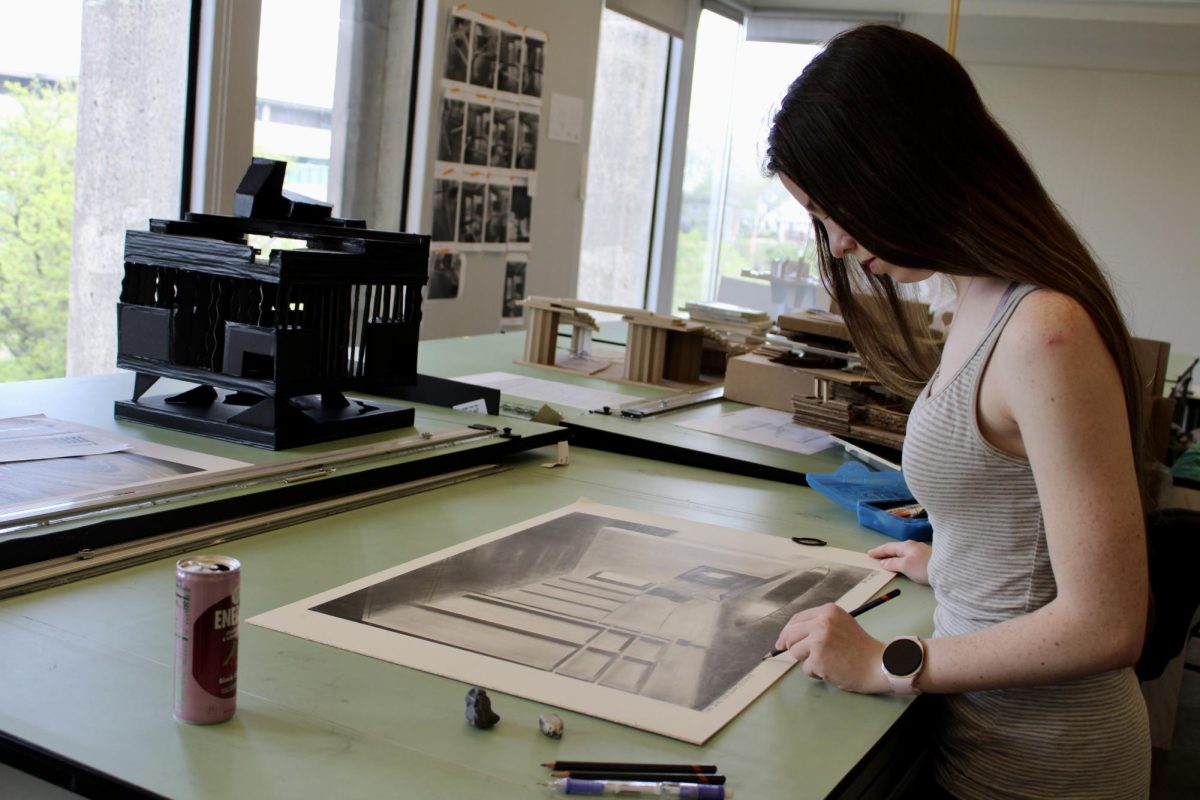
The first classes of students in the newly added five-year Bachelor of Architecture program described their experiences as consisting of late nights, strict deadlines and countless hours in studio classes.
The Bachelor of Architecture major map states the minimum nine credit hours spent on projects within studio classes help mirror and showcase what students will experience working at a design firm. Students are consistently working and transitioning from project to project.
“Our building model was due yesterday, and I would say mine is 75% done, but there’s definitely late nights,” said Ruben Renteria, a second-year architecture student. “It’ll get kind of crazy the next couple of days.”
Sophia Dunahee, a first-year architecture student, shared a similar experience, reflecting on the time it takes to meet deadlines.
“I spent two mornings here until 8 a.m., and I spent another all-nighter trying to get a project done,” Dunahee said. “It’s definitely very, very time-consuming…I don’t feel like it’s like a job, but more of a fun activity.”
Students in the program described how passion and enjoyment drive their work, even if it requires lots of time.
“I really pour all my time into my projects, and so I try to be as diligent with how my craft is or how my models look,” Renteria said. “I just give it my all, so it just takes a little longer.”
Dunahee said strong relationships with classmates are built through shared experiences, especially in stressful moments.
“I have a memory of being here at I think 4 a.m., and there were a few other people. We were all stressed, but at the same time, we were playing music, we were all singing, we were having fun and that just got us a lot closer together,” Dunahee said.
The support of professors like Christopher Spaw, whom Renteria described as “accessible” and “approachable,” makes it easy for students to reach out about the program and projects.
Renteria and Dunahee both said office hours help get one-on-one help from professors.
“Professor Spaw and Professor Musso get along with all the students, which is very nice. They explain things in a way that makes sense and that you can actually understand, grasp the idea, and then turn it into art, whether it’s drawing or if you’re building something,” said Dunahee.
The program’s Kansas City location allows for benefits like visits from architects and access to nearby firms.
“This program, I think, will be really beneficial for the Kansas City area,” Renteria said. “It was definitely long overdue for this program to exist here.”
Dunahee believes there is one thing the program could refine in order for students’ success. The first-year studio is divided into two parts, which leaves students working on different projects.
“I think that the project should be the same no matter which side you’re on,” Dunahee said. “If you’re here at 2 a.m. and no one’s on your side, but there are people on the other side, you can’t go to them for help.”
Despite the difficulties that come with being a part of a newer program, students are dedicated to continuing with their work.
“I’m enjoying architecture and learning, and I’m really enjoying the process of how my building’s coming out,” Renteria said. “I’m here to stay and go through the motions of the experimenting that will happen.”
![[FILE] Roof blown off downtown business after storms on April 23.](https://kcroonews.com/wp-content/uploads/2026/04/Image-88-1200x900.jpg)