Banned Books Week, Oct. 5-11, is a week dedicated to efforts against censorship and book bannings in libraries, schools and bookstores.
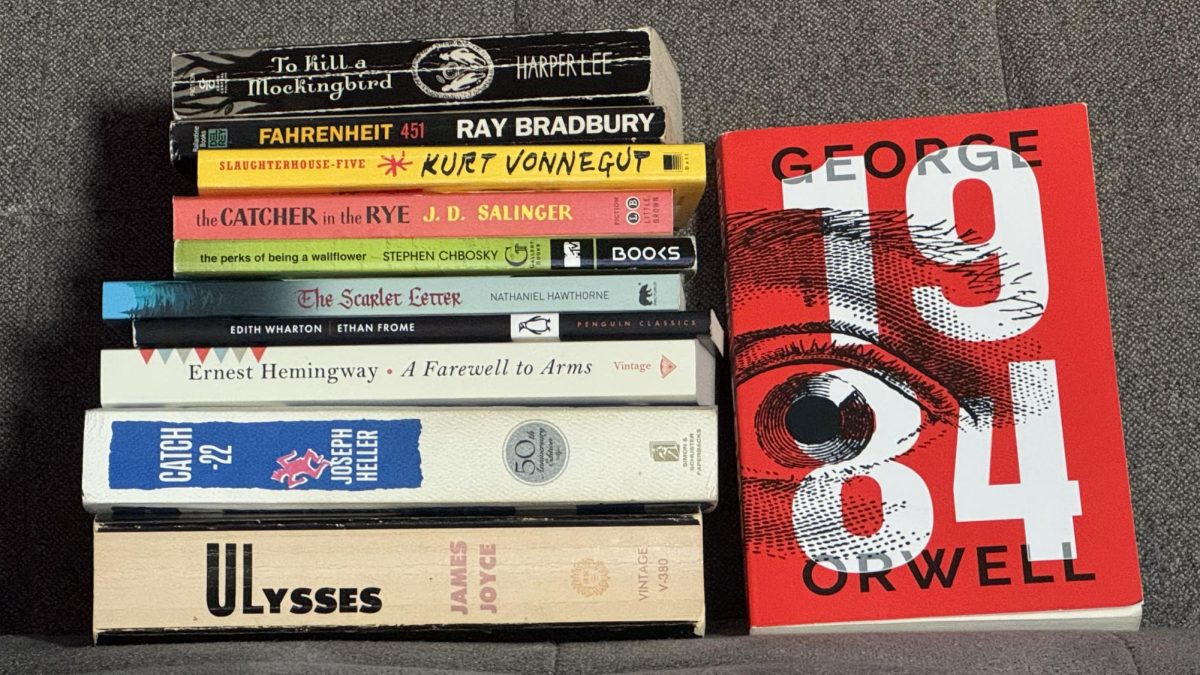
The theme for this year was “Censorship Is So 1984. Read for Your Rights,” announced by the American Library Association and Banned Books Week Coalition. The theme is a nod to the famously controversial book 1984 by George Orwell, a dystopian novel about authoritarianism and mass censorship.
Although UMKC has not planned any events related to Banned Books Week, students and faculty are well aware of what the occasion means to them.
“No book should be banned. Books are works of art, and to ban art is to ban humanity,” said Tristan Starner, a sophomore English major.
“Banned Books Week is also a celebration of those materials and freedom of information,” said Coryell Deege, LaBudde Special Collections and University Archive Assistant.
The history of book bannings and censorship has evolved throughout history, with censorship in 2025 being focused on books about race, LGBTQ+, as well as those discussing sexual content and sexual violence.
“You get to look into another person’s mind on the page. That experience can only expand your perspective on the world. Banning books forces a limited experience,” said Starner.
“When books are banned, it limits and alienates those perspectives,” said Kristin Grider, a junior English major.
Book bans usually occur within schools. During the 2024-25 school year, there were approximately 6,870 instances of book bannings in schools. This number may be bigger, considering the data relies on book bannings that are reported, and there may be unreported instances of banning or censorship.
The practice of preservation is extremely important when combating censorship.
“For us archivists, we want to preserve everything, and it is the antithesis of our mission to preserve everything when we restrict access to books and other materials,” said Becky Briggs Becker, University Archivist and interim head of LaBudde Special Collections.
Mass censorship makes the jobs of archivists important. Digital copies of media can be fragile, making physical copies of texts necessary.
“I would say physical is very important,” said Deege, “unfortunately, some of the digital media is also at risk for bit-rot, to where, let’s say you have something saved on a floppy disc or CD. It still degrades electronically on there to where it’s unreadable.”
Banned Books Week started in 1982 after a surge in censorship and banned books culminated in a Supreme Court Case. The court found that the banning of Slaughterhouse-Five by Kurt Vonnegut, among eight other titles, was an infringement on the First Amendment rights of students.
Pushing back against censorship continues to be a priority for the American Library Association and Banned Books Week Coalition, as well as for students and faculty.