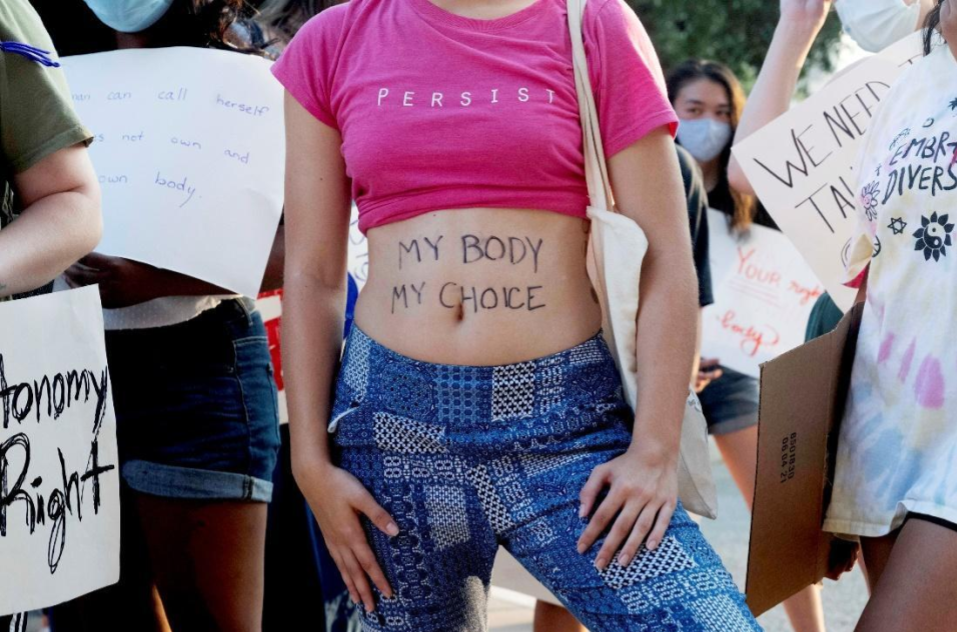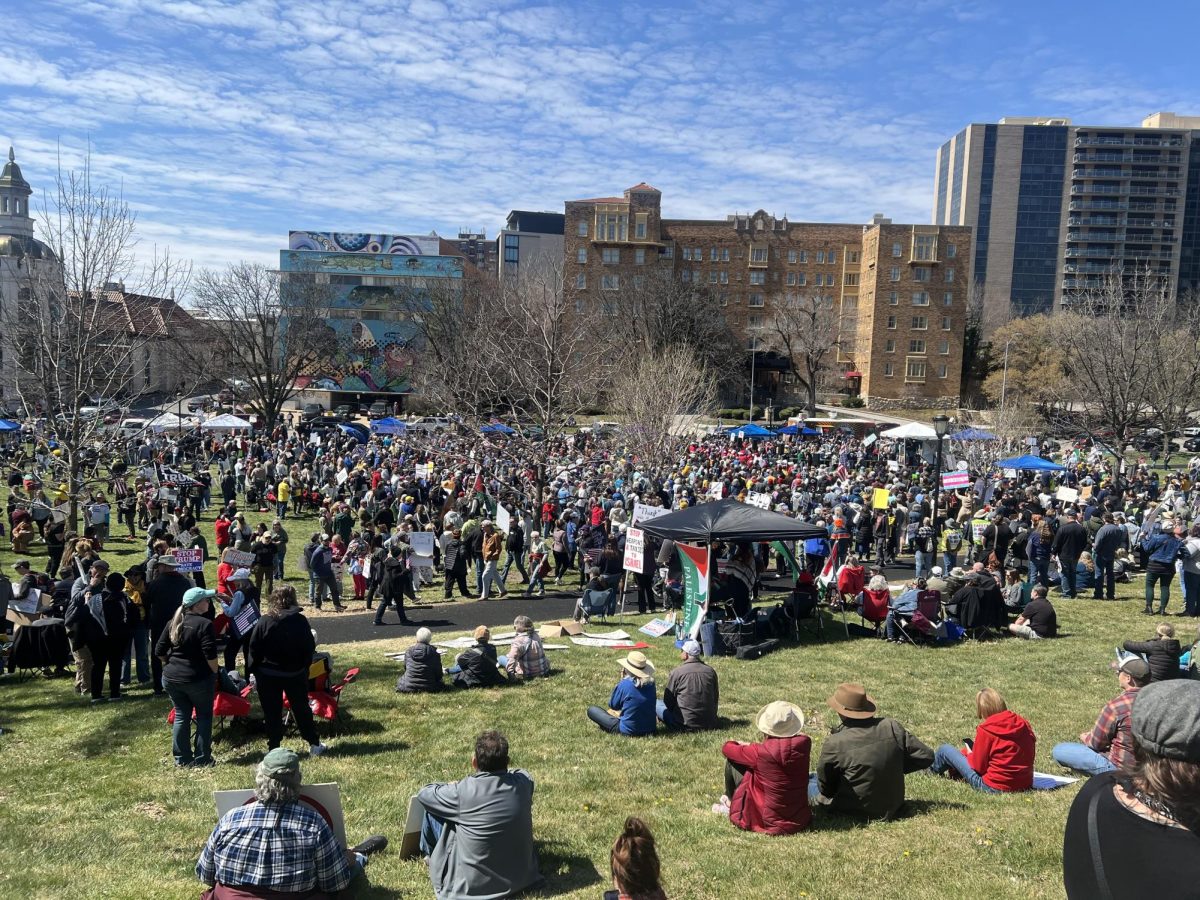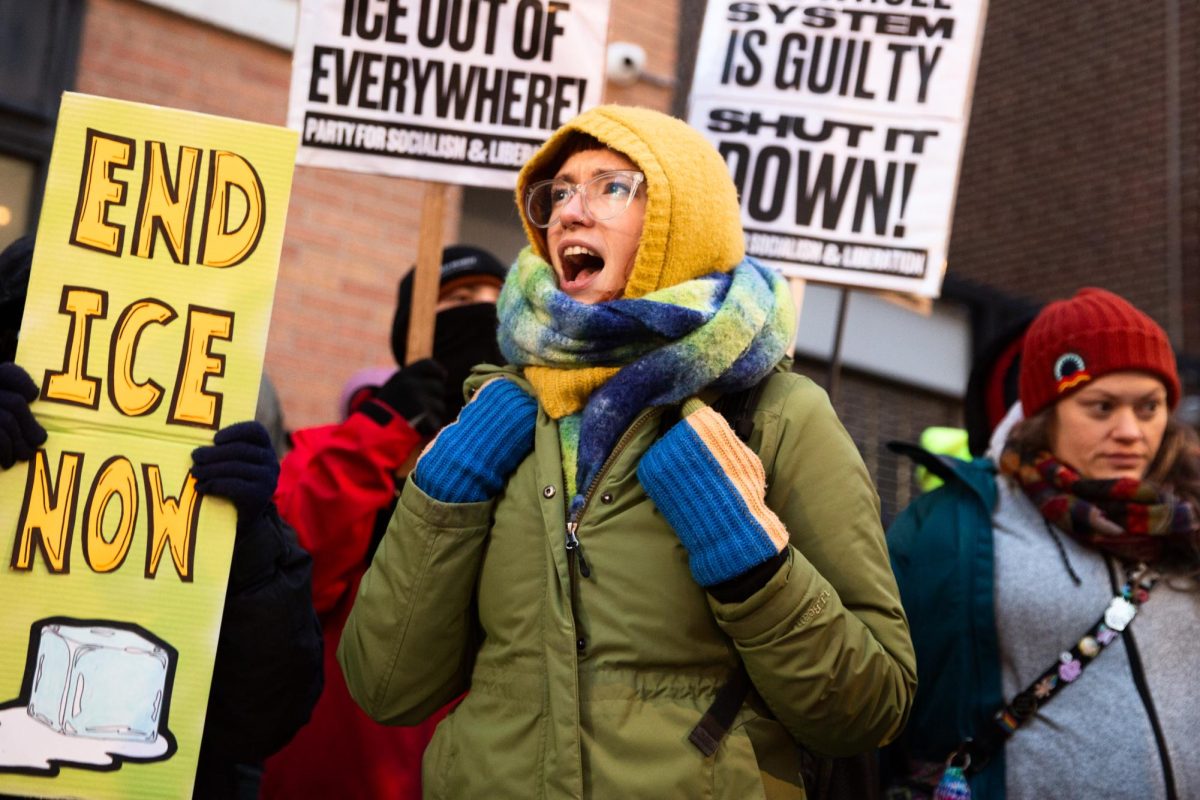
UMKC students, graduates and faculty joined swarms of protesters across Kansas City to support the Jan. 30 national shutdown, calling on the U.S. Immigration and Customs Enforcement (ICE) to stop its military-style deportations.
Several demonstrations were held on Friday responding to the large-scale ICE operations across the state, including one at WWI Memorial Park and another in Oppenstein Park. The latter protest involved a three-block march to Hotel Kansas City over financial ties with Platform Ventures, a KC warehouse to be used as an ICE detention center.
“I am a child of immigrant parents. I have friends who are immigrants. I see what’s going on, and I see folks suffering and being kidnapped, being killed for just living their lives,” said 35-year-old UMKC alumnus D.C. Okonta. “Folks should have that opportunity just to live here without being targets for something that they’re not about.”
Advocates for Immigrant Rights and Reconciliation (AIRR) confirmed multiple ICE spottings in January, including one around I-29 South on Jan. 27 that led to one arrest.
Party for Socialism and Liberation Kansas City (PSL) was one of many activist groups to aid and guide protesters. PSL branch member Mitch Schiller said their group began organizing “immediately” after hearing Minnesota’s call for a shutdown.

“I’m a strong believer of using your voice and presence when it matters. I grew up being told America was a place for everyone and a safe haven,” said criminal justice and political science senior Sage Pundmann. “I wish it wouldn’t have taken people being murdered for the protests against ICE to become so large and mainstreamed, but I am glad they’re happening regardless.”
Pundmann attended the protest in Oppenstein Park and has attended several protests in the past. They added that other forms of activism, such as contacting lawmakers or donating to local organizations, should be practiced alongside protesting.

Okonta also mentioned that disrupting the structures enabling ICE operations and other U.S. issues is crucial for effective change.
“Protests like this are great. I love to see people out here. We just got to make sure that we’re disrupting these systems because these systems are the things that are causing a lot of the issues that are here in Kansas City and throughout the United States,” Okonta said.
Brianna Biondo, a sociology major at UMKC, said that the turnout at Oppenstein Park felt “invigorating” and “powerful” to experience, especially amidst the cold conditions.
“Protests like this that bring ICE brutality and its victims to the forefront reflect [pressure], as many media outlets and government officials alike are attempting to twist the narrative by justifying ICE’s murders or as reframing them as something entirely different,” Biondo said.

Jordan Smith, UMKC’s Graduate Medical Education (GME) senior coordinator, also joined the 5 p.m. protest in solidarity for “people who are afraid to leave their homes right now.”
“I think it’s a powerful visual just to see people collected in the same space together,” Smith said. “Protest is everything. I think it’s so important, and there are people driving by who might not have known this is an issue.”
Kansas City organizations and small businesses took part in the economic blackout, including The Westside Local, Lily Floral Collective and Turnsol Books.
Protestors also lined up on Ninth Street outside of the offices of Sen. Josh Hawley, Sen. Eric Schmitt and Rep. Sam Graves, calling against the Platform Ventures deal with the Department of Homeland Security (DHS).
![[FILE] Roof blown off downtown business after storms on April 23.](https://kcroonews.com/wp-content/uploads/2026/04/Image-88-1200x900.jpg)

![[FILE] The Starbucks in the Student Union.](https://kcroonews.com/wp-content/uploads/2024/10/Edited-1-7-1200x900.jpg)
![[FILE] One of the baby shirts apart of the Clothesline expressing a firsthand account of sexual assault.](https://kcroonews.com/wp-content/uploads/2025/10/lc-5-1200x900.jpg)