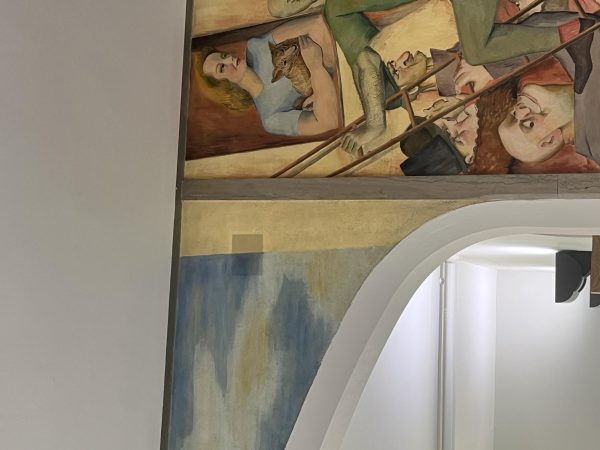
Familiar faces are getting a touch-up this summer on the second floor of Haag Hall as the Quintanilla-Project Team has begun a five-week mural restoration.
The project has been in motion since 2020 when an initial assessment was done by Iñaki Gárate, team lead for another of Quintanilla’s works and Esther López Sobrado, professor of Art History and expert in Quintanilla’s art. Gárate reported on the mural’s condition; however, the pandemic halted the restoration progress.
Former-student Victoria Dominguez and Dr. Viviana Grieco, a project lead and professor of history and Latin American and Latinx studies, used time during the pandemic to start researching the stories of those painted on the mural.
“We’ve been building these blocks. You start very small with primarily the attention to the campus community, then you have a website, people start finding you, then you make the project bigger and bigger,” said Dr. Grieco.
The mural, titled, “Don Quixote in the Modern World,” was commissioned in 1940 by UMKC President Clarence Decker. Luis Quintanilla, the mural’s artist, was a political refugee from Spain, who was also the university’s first artist-in-resident.
The mural was cleaned in 1995. However, there is no official record of who did the cleaning, only leaving behind a square untouched to demonstrate how dirty it was.
The funding was secured through a series of grants, most notably the Mellon Foundation. The entire budget is around $160,000, which will be used throughout the next three years.
“Public funding is not always available and the arts and humanities have become targets of political debate. Without sustained care and community engagement, murals can indeed become a lost art,” said Dr. Joseph Hartman, an associate professor of art history.
+ HOW THE GRANT WAS ACQUIRED.
Previously working with Seville Sister Cities, UMKC professors Grieco and Alberto Villamandos were writing grants for restoration and having trouble receiving funds as the mural was in okay shape, compared to pieces that needed greater attention due to lack of preservation.
When the Kansas City Monuments Coalition approached, it was an easy sell because research already was completed on the mural’s history and since many of Quintanilla’s pieces were destroyed in the Spanish civil war.
The Kansas City Monuments Coalition was willing to include the Haag Mural as a part of the monuments around town needing restored.
Restoration was quickly started after funding was settled in early July of 2025, allowing them to begin cleaning.
+ THE PROCESS
The mural is a fresco, which is created by applying wet plaster to a surface and mixing water with pigments to create a solidified picture.
The first step was photographic analysis. UV lights pointed out all the issues not noticeable to the human eye, like leftover tape pieces across the marble and plaster.
Gárate said the now permanently shut windows once caused issues due to the humidity and lack of circulation. Furthermore, smoking used to be allowed in the buildings, which may also have caused unknown damage at the time.
To combat the “pollution” that has accrued on the mural, a soft Japanese paper is applied with distilled water, and left for 25 minutes until they can go in with brushes to remove the dirt.
Frescoes being plaster makes them “spongy” and this soft cleaning technique reduces the chances of damaging the art.
Detailed records will help the next team, which will clean the piece down the road.
+ MEANING BEHIND THE ART
When making the mural, Quintanilla used the faces of UMKC students, faculty, staff and even his wife and son.
Bill Montgomery, a boy wearing red who is located in the bottom right corner of “Don Quixote in the Twentieth Century,” is currently 95 years old and the only living member of the mural. Adam Sisk, a student working on the project, was able to interview Montgomery.
“Their preservation allows us not only to honor a gifted artist but also to reflect on the values he risked everything to defend,” said Hartman. “The figure of Don Quixote challenges us to consider what it means to act with conviction, to resist injustice, and to uphold human dignity, even when the odds seem insurmountable.”
“Don Quixote in the Twentieth Century” also features distinctive fascists from the time like Mussolini and Hitler, holding open a Hippo’s mouth, showing the horrors of facism.
When President Decker brought Quintanilla to campus, it gave students another opportunity to connect with faculty in a hands-on learning experience. Not only were they able to watch the process of making the mural, but they became the models for it themselves.
“Take a second to look up, to pause, and appreciate what’s right in front of you. You might stumble upon one of the few surviving works of art Quintanilla left for us,” said Dominguez.
+FUTURE OF THE MURAL
Many students have been involved in the murals’ restoration process, and research is still being done to discover more about the Quintanilla and the mural itself. Any student wanting to get involved can connect with the project leaders to further their research idea.
When the restoration is complete, the next step will be to create an informational kiosk kept adjacent to the mural. This will provide information about the mural itself and specifically who is on it.
Further down the road, the team is working on a documentary revolving around the restoration process.
“The work of the Luis Quintanilla’s Murals Restoration Project is done in partnership with the Kansas City Monuments Coalition. KCMC is a collaborative initiative that supports preservation and commemorative organizations across the city and is funded by a generous grant from the Andrew W. Mellon Foundation.”
![[FILE] Roof blown off downtown business after storms on April 23.](https://kcroonews.com/wp-content/uploads/2026/04/Image-88-1200x900.jpg)